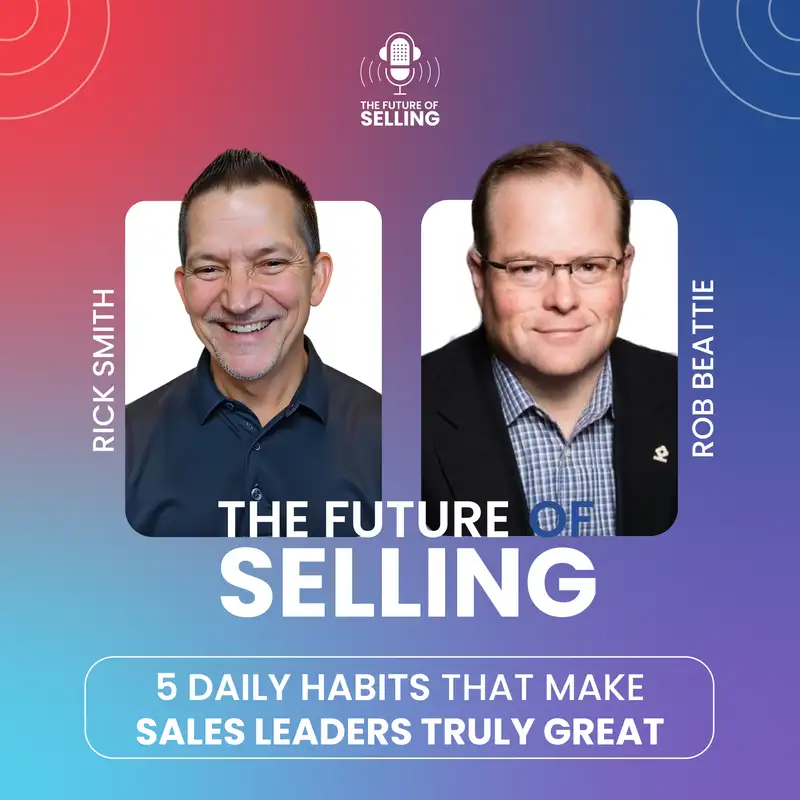
5 Daily Habits That Make Sales Leaders Truly Great | TFOS 26
Future Of Selling (00:01.397)
All right. Hey, welcome to the Future of Selling podcast. We so appreciate you being here today. The Future of Selling podcast, right? This is where we dive into challenges, innovations, anything impacting the future of sales or the sales landscape. I'm your host Rick Smith. I'm so glad that you joined us today. Our guest today is Rob Beattie. So Rob is a seasoned sales leader who most recently led sales acceleration at a company called ModMed.
And this was written, he was there for a little over four years. this was after nearly 15 years rising through the leadership roles at Thomson Reuters. So he actually managed teams of over 200 people. So Rob was also recognized as AISP executive of the year a few years ago, and he served on their advisory board as well. He's also known for his signature framework.
the five daily goals and we're actually absolutely going to jump into that today. He's a frequent speaker and content creator, so really interested to kind of dive into some of the things, some of the things he's thinking about, his thought leadership. And what really sets him apart is his emphasis on empathy and discipline and the daily rituals that you need to have over just kind of flashy tactics as a professional salesperson. So I'm completely ready to dive in, kind of learn more about Rob.
what he's doing, what he's thinking about, and these five daily goals. So Rob, hey, welcome to the podcast, man. Thanks for being here today.
Rob Beattie (01:31.725)
Thanks for having me. really appreciate it. Excited to be here today.
Future Of Selling (01:34.291)
Yeah, absolutely. We're to have a great conversation. Before we jump in though to a couple of topics, I always like to start with a few kind of fun facts and just things that we, you know, if we're doing research and learning a little bit more about you and just a couple of things that we find in that process and also just a way to kind of, you know, make you a little more human to the audience, right? Not just some guy who knows a bunch of stuff, but like a regular person as well. So fun fact number one.
During COVID, you set up your home office in your basement and somehow it became known as the Bunker of Love. So I'd love to hear about that guy. What is that about? Tell us the 30 second story on that.
Rob Beattie (02:15.158)
Yeah, So yeah, there was, you know, I'm somebody who tries to have fun. I try to make people kind of snicker sometimes. I like to bring a little bit of a sense of humor. There used to be a TV show called Mystery Science Theater 3000. was back in the 90s. It was a guy and two puppets and they would watch bad old movies and they would talk through it. And they were stationed in something they called the Satellite of Love.
Future Of Selling (02:40.457)
Right.
Rob Beattie (02:44.87)
And so when COVID started, when we thought this remote thing was gonna be just literally a couple of days or a week, you know, I remember thinking, well, we'll get through spring break here and then everybody be back at school and everything's gonna be back to regular. I purposefully designed my space to look like a, you know, like, like it was just temporary. Like I was just kind of hiding out somewhere.
and it was trying to send a message to my team at the time of, don't worry, this isn't gonna last very long, we're in a temporary spot. And what I found is as we evolved and kept going, I just kind of kept the moniker of the bunker of love, but made it look a little more professional. I'm actually sitting in it right now. And so it looks like I'm in a real office with all this stuff, but if I was to turn the camera around, you'd be like, wow, there's a swing set and a basketball hoop.
Future Of Selling (03:26.249)
No.
Future Of Selling (03:33.216)
That's awesome. All right. Well, I love it. I saw it and I'm like, hmm, I kind of got to know more about that.
Rob Beattie (03:38.364)
Yeah, well somebody somebody it was once said you said the dungeon of love I'm like, no, no, no, that's over there But I was like, no, it's not very different very different concept
Future Of Selling (03:47.968)
Got it, got it. All right, I like that. Okay, other fun facts. So you're a mini Yeti cocktail glass collector and you've got one of ours from Conquer, which is where I'm the chief customer sponsor of our podcast. I love that. that man, once people get their hands on that Yeti, they never let it go. it's a really good cup. And then last thing is I thought this was funny because if this is accurate, then I'm worse than you.
Rob Beattie (04:00.143)
yeah?
Rob Beattie (04:07.371)
No, that's a good one.
Future Of Selling (04:15.861)
is that your LinkedIn headshot was about eight years old and you haven't updated because you kind of like the look of that picture, right? It makes you look young. And when I saw that, I started laughing because I'm thinking, okay, my headshot is probably like 15 years old.
Rob Beattie (04:25.962)
Correct.
Rob Beattie (04:33.961)
bet mine's pretty close too. A lot of people these days will take a headshot and they'll change it around or whatever. And one, I'm not even sure I could go into LinkedIn and change the headshot out. I'm not sure I'm technically savvy enough. So I just leave it and figure you'll get the real deal here.
Future Of Selling (04:49.909)
Yeah.
Future Of Selling (04:55.881)
Yeah.
Rob Beattie (04:56.223)
You know, and this is living proof that I'm a human being, not a machine, because if AI decided to like say, hey, let's make this face, that would be the end of AI right there. That's when you know the robots are taking over.
Future Of Selling (05:06.837)
I love it. love it. All right. Okay, cool. Well, just a couple of fun facts. Thanks for kind of going there with us. So let's kind of jump into it. Really wanted to talk about kind of, you know, how, I mean, today, if I had to put a theme on it, right, the theme of it for me anyway, was how small and intentional habits and empathy driven leadership, how does that shape selling and certainly shape the future of selling? So, but as we go there, I wanted to check in on this. you,
I wanted to find out kind of what you're doing now because I know you just recently left your role at ModMed and you're referring to this time as free agent mindset. So tell me about what that means and where you think you're headed.
Rob Beattie (05:35.902)
Yeah. Yeah.
Rob Beattie (05:43.977)
Yeah.
Yeah, well, thanks. You know, I, I call it either my free agency period or sabbatical. Like I can't decide exactly what that means. Right. But, you know, I'm in that sort of nascent part of my career. You know, I've, I've been in this game for a very long time. I was joking with somebody the other I've had a job since I was 13 years old and that was a very long time ago. And that job was paper delivery, right? Newspaper delivery boy. So
Future Of Selling (06:08.373)
Yeah.
Rob Beattie (06:14.674)
I used to tell young people, yeah, I delivered the internet door to door. And you think about how far we've come from there. And I sort of got to this point now where I'm like, you know, I'm going to step back. have an opportunity to just sort of think and recalibrate and reset. you know, is this the time where I go forward and keep going into the sort of larger team roles, third line leadership, that kind of thing? Is it time to look at being a first line leader again?
do I want to move into sort of a consultancy type role? I was looking at some things I enjoy and it's kind of that almost guru mindset of, I help people as they come along? And I can probably do a blend of all of those. And so just taking some time to think about what fills me up, what do I enjoy the most?
you know, so I can kind of have that work life balance piece that people always are striving for. I sort of said, you know, I'm going to take the time now to do it. know, I've got probably another 10, 15 years running me and I don't think between now and then I would do it again. So this is kind of the time to think about that. so exploring a lot of different opportunities, looking at different industries, just really kind of thinking. then honestly,
Every day I'm doing some reading and some study and I'm looking into what are some of the other thought leaders out there thinking these days. You I'm, you spend so much time in that daily, you hit the number mindset, right? That sometimes just stepping back gives you that chance to refresh. Maybe you get a new perspective. Maybe that next acceleration you get on will be the, you know, a breakthrough for somebody in some way. it was, but it was interesting. I will tell you my first day.
Future Of Selling (07:48.469)
You're right. Yeah.
Rob Beattie (08:05.385)
I found myself literally wandering in circles in the kitchen. Like I'm just in totally completely disoriented. And my wife says, what's going on? I'm like, I've had a sales number for so long that I don't know what to do right now. You know, and she was, why don't you go clean the basement? I'm like, that's a great idea. So.
Future Of Selling (08:23.126)
Go clean the bunker of love.
Rob Beattie (08:27.272)
Clean the bunker, right? The rest of where I took all the stuff from the bunker of love and just stuck it over there five years ago, now it's time to clean it all up. So yeah.
Future Of Selling (08:32.544)
Yeah. Yeah. I love it. I think that's a really good perspective as we go into these times. And I remember a time when I had about a month in between roles and I didn't take enough. If I, a mentor of mine that I worked for for years, he told me when I went into that time, said, dude, go on vacation, go relax. Don't rush yourself into this thing. And I'm like, yeah, thank you for that advice. And boom, and I'm just rushing into it as good as I can.
Rob Beattie (09:00.177)
Right. Right.
Future Of Selling (09:01.802)
Looking back, I do wish and do agree that when you're in these times, slow down, think, figure out what is that makes you come alive, just like what you were saying. What am I good at? What do I love to do? How can I put my skills and my knowledge and work to better people?
Rob Beattie (09:21.053)
Definitely and it's funny, you know people say all the time you won't regret the time you take and I'm I've listened I was terrible about it and in you know, I am NOT a good user of paid time off I am NOT a but first things first as it relates to that stuff You know, I would think you said I was at Thompson for 15 years hit a Friday Mod Med on Monday, you know And so I sort of grew up in that era of hey, you always need to have a job. You always need to be doing something
Future Of Selling (09:34.166)
Yeah.
Future Of Selling (09:42.804)
Yeah. Yeah.
Rob Beattie (09:49.73)
And so literally just kind of breaking the mold, you know, and just seeing what comes of that.
Future Of Selling (09:54.347)
Yeah. Yeah, I think that's fabulous, man. I think it's just fantastic you're taking the time. Are you reading? You said you were reading a bunch of stuff. Any anything particular that stands out to you that you'd say, man, here's a great read.
Rob Beattie (10:05.33)
Yeah, I've been, you know, I'd sort of been hitting stuff online, spending a little obviously a little bit more time on LinkedIn than I was doing when I was, you know, working because I wasn't really what I thought to do. So just picking up different pieces, different blogs as those go. I'm actually going back to some of the books that were defining books of my career, like Cracking the Sales Management Code by Jason Jordan is one that was hugely influential for me.
And just been a long time since I looked at it. There's a book called Managing Transitions as I'm going through a transition that I'm reading daily just to think through that. There's a book called Switch by the Heath Brothers, another older book, but it's about change and change management. While I'm doing that personally, I also believe that wherever I go, wherever I land, there's going to be some reason that I'm coming in. You don't usually go and look for somebody of my experience if everything's going swimmingly.
Future Of Selling (11:03.242)
Yeah.
Rob Beattie (11:03.524)
And so, you know, getting back to thinking about, okay, what would that playbook look like when you come in? generic, right? Like you don't know the real answers. And, but when you have that, when you sort of have that playbook of what I want to, what I think is going to happen, what I know changes an organization, then you can go into the heads down, shut, figure out what's actually happening, take those pieces and plug them in. And you can go, I think a lot faster in that type of.
Future Of Selling (11:31.969)
Yeah. Yeah. Yeah. So the theme I would take from what you just said is when you do have it, if you're going into a new role or like you, if you've got this time in between roles, right, that's your time to sharpen the axe. That's not the time to get into worry. That's not the time to just go on vacation or just clean the garage, right? That's really time to start sharpening the axe day by day so that when you go into your new role,
Rob Beattie (11:33.24)
and that type of change.
Future Of Selling (12:01.792)
you're ready to roll and you've kind of developed a good perspective. I think that's incredible. Yeah.
Rob Beattie (12:04.914)
Yeah, yeah, yeah. And I'm super lucky. My wife is a business coach and executive coach and HR and all that stuff. So I have the opportunity on a daily basis to connect with somebody who understands that side of it and is doing a lot of that work so I can hear her stories and her experiences and think about how that would apply to myself. it's finding somebody if...
that's not somebody you live with, somebody like you said, a mentor or somebody that you've spent time with before to just connect with so that you're keeping your head in the game, super, super important, I think as well.
Future Of Selling (12:42.646)
Yeah, completely agree. Well, let me dig down into a little bit of your experience because this is probably a really good time for this question. you, Thompson Reuters, right, to ModMed, I think if I read everything right, that's probably about a 20 year experience just between those two. You've led sales teams of all sizes, right, you big, small, all these things. So and you've seen shifts in the way the business works. So
How do you think sales organizations need to operate today compared to maybe 10 years ago, even 15 years ago? I what's, what's, what's changed from your perspective?
Rob Beattie (13:20.027)
Well, it's fascinating because obviously the influx of various tools and today that tool primarily one is AI as a real impact on how somebody goes about the daily job. And so understanding that piece of it, I think is critical for sales leaders. You know, do you need technology? How would you use technology? And is it having an impact on your people?
Future Of Selling (13:29.611)
Yeah.
Rob Beattie (13:48.259)
is the way that I would think about that because that's been the biggest change. There's one thing that hasn't changed, which is hustle wins. I will always say those who work harder tend to have more success, right? Like that's just a fact of life. so 20 years ago, when I was first getting into Thomson Reuters, even prior to that, there was a company I worked at called New Horizons Computer Learning Centers. And my first day there,
They were arguing if salespeople should get email or not, right? Like, is that something we would ever use? And you then saw, you know, it's crazy, right? You then see this digital shift and everybody's trying to figure out still, I think, how do you digitally interact with people? How do we shorten that sales cycle? How do you capture intent? And what's interesting to me is one of the things that I've been thinking about is how little
Digital intent is actually somebody showing up to buy. They are, in my mind, not much different. You the old inbound, outbound argument of a lead, like an outbound lead is more cold than an inbound lead. I don't think they're that different in today's world because so many things capture the digital footprint as you go through. People tend to overreact, like this person hit our website. They must be ready to go.
Future Of Selling (15:15.254)
Right.
Rob Beattie (15:15.844)
And I think people then skip sales steps and skip that piece of developing the relationship early on. Like you should treat everybody like they are cold top of the funnel because they most likely are.
Future Of Selling (15:27.265)
Yeah. What does that mean? I don't mean to cut you off, but I want to answer that question. What does that mean? So if I'm going to treat someone like they're cold top of the funnel versus I'm convinced they're at the bottom of the funnel ready to mark because they hit my website. What does that mean to treat them like that?
Rob Beattie (15:33.679)
Yeah, no.
Rob Beattie (15:42.618)
Yeah. Yeah. Well, I mean, to me, it really means get to the basics of their business or whatever you're selling, right? Like whatever the reasons are that somebody could buy your product or use your product, assume they have no idea, right? Like take them from if I was to go meet somebody on the street and explain what we do and how we do it.
take that mindset into your first interactions and calls as a salesperson with them. One, it's going to give you a much stronger foundation when the time for negotiation comes, because that time's eventually gonna come, right? Nobody spends what they initially think they're gonna spend, you as a salesperson think they're gonna spend anymore. So you've gotta have that basis of, if my product is something that changes the way that you interact with your clients,
have that conversation, don't assume that they actually know. And what I see from a lot of people is, if I get a digital thing, I'm assuming they know something, right? Like, I don't know how many companies run webinars, as an example. People will sign up for webinars and people are like, oh my God, they're so excited, they're gonna buy our stuff. And I'm like, that's just a guy signing up for a webinar. And, you know, your question isn't, are you ready to buy? It's, hey, I saw you signed up for this webinar. Can I ask, what were you curious about?
Future Of Selling (16:54.647)
Yeah. Yeah.
Future Of Selling (17:02.561)
Yeah.
Future Of Selling (17:09.953)
Yeah. Yay.
Rob Beattie (17:11.065)
You what took you took the time to schedule that or to even sign up for it. What was it that you were interested in? Because it's not your product. It's probably something about a problem that your product could solve. And that's what they're actually out there looking for. You know, most people have issues and problems at their business, but they have no idea how to solve them. And as a salesperson, oftentimes we know our product solves that problem.
And so we skip the piece of teaching that buyer, teaching that prospect why and how we do it.
Future Of Selling (17:46.85)
Yeah, yeah. No, I think that that's great. And as you were kind of going through that, you know, I thinking about how that that approach kind of flies in the face of what I've heard some other people say in that in that way, buyers today are so educated on your product, right? They know exactly, know, because they're doing 60 percent of the research before they ever talk to you. And that could be true in some cases. But I think what you're saying is, hey, that's a
That's probably not a great assumption. And if it is your assumption, you need to truth check that and make sure. Otherwise, one, you're not going to figure out what the problem is, right? You're just going to pitch them the product and how it clicks here and goes there. And you're not going to get it. So, okay.
Rob Beattie (18:17.86)
Correct.
Correct.
Rob Beattie (18:34.052)
That's the fastest way to put yourself into a bake off with a competitor for somebody's business. And also most likely, especially in a technology world, they have something you have to replace. They have something today. And that comfort level that they have with that, you better have something really interesting. I just use the example.
Future Of Selling (18:48.397)
Mm-hmm.
Rob Beattie (19:03.46)
of I have a house, I have a great house, I have a house big enough with a basement that I can have an office in it, right? Like it's a great house. It's good schools, all of these things. If somebody was to call me up today and say, hey, would you like to look at a different house? I'd be like, no. And I also don't wake up in the morning and say, you know what I need? A new house. You know, but if somebody came to me and be like, hey, have ever thought about living on a lake? I'd be like, hmm. You know, and if anybody ever was to look at houses I look at, you know, when I'm
thinking about it. think about living on a lake, you know, and so if if that ever was that that process of discovery and understanding is going to make me far more likely to make a big decision on something that would replace something I have today, then I'm super comfortable.
Future Of Selling (19:34.231)
Right.
Future Of Selling (19:50.776)
Yeah. Gotcha. Gotcha. Yeah. All right. That makes sense. so if a realtor is listening, by the way, find a place on the lake and talk to Rob. Just saying. Just saying. So cool. Well, kind of related to what you're talking about, right, you've been described as the empathy guy in sales leadership. So what does empathy actually, what does actually look like in daily sales management?
Rob Beattie (19:57.313)
Yeah. Found a nice lake house. Yeah. I'm sitting around right now. Like now's the time.
Rob Beattie (20:19.054)
Yeah.
Future Of Selling (20:19.352)
And where do most and as a leader, mean, maybe we talk about the leaders and we talk about the sellers themselves. But, you know, where where do most leaders miss the mark on this idea of empathy and how to do that?
Rob Beattie (20:30.039)
Yeah. I think one of the things that I see that people focus on where you lose it is you focus when people focus on outcomes, not process. Right. And so as a sales leader, as a leader, I don't, doesn't matter if it's sales or not.
Future Of Selling (20:41.346)
Okay.
Rob Beattie (20:51.587)
Having a process by which people approach, that's the actual piece to spend your time on in the coaching. I see too many people as leaders come and be like, oh, Rick, you're at 70 % of goal. I need you to be at 90 % of goal. Good luck. And I'm always like, back it up to the process. What is it that they're doing or not doing?
Future Of Selling (21:08.397)
Right.
Rob Beattie (21:15.488)
because there's a, I always have enjoyed the sport of football, as you can probably guess by my shirt today. Bill Walsh had a great book called The Scorer Takes Care of Itself. He was a coach of the 49ers, super successful. I'm not a fan of the 49ers, but I liked his book. And the concept of that was, look, if we do the basic stuff, day in, day out, if we do things proper, if we follow the right technique, the outcome of scoring a touchdown is going to happen.
Future Of Selling (21:34.274)
Ha
Rob Beattie (21:46.208)
And it's the same mindset that I think you have to bring to your daily leadership and coaching and all of that stuff with your sales reps. Like understand what are they doing? And that's the piece where you've got to get in the trenches with them. You have to listen to those phone calls. You have to look at their emails. You have to see their interactions. Like that stuff is where you really will uncover what are they doing and how are they doing it? You also as a leader have to give them a process that is something for your sanity.
that you want everybody doing the same types of stuff so that you've got the ability to coach within a model as opposed to coach the individuals. And I know it sounds almost like I'm saying two different things, but if I give you a model, you as an individual can perform to your highest level. And I think that's one of the goals that leaders have to have.
Future Of Selling (22:39.49)
Yeah, yeah, agree. I've got a kind of a leadership framework thing I work on and kind of work to adopt as well. But that's what that's one of the things right is as a leader, it's up to you to define the standards, whatever the playbook is. And in sales, the sales process, right? I that's one of your responsibilities. And by the way, now that you've defined that that process, you're not just walking away to your point and saying, hey, you're at 70, you need to hit 90 percent instead.
It's about, now how do I actually hold you accountable to that process? How do I coach you to that process? And how do you get better? Because if I'm your sales rep, Rob, that's what I want. I want you to help me. I'm not just looking at you to bark at me. I'm looking at you to lay out the process, but then also coach me into it. Help me see where I'm falling short and help me see what I'm doing well and then help me achieve results.
Rob Beattie (23:18.689)
Correct. Right. Right.
Rob Beattie (23:33.442)
Yeah. One of the one of the best visuals I ever had from somebody was it was a sales rep I worked with man 25 years ago. It was a long time ago. His name was Alan Finley. Great dude. And Alan and I were talking and he says to me, I can't even remember if I was even a sales manager at this time. I would you know, but he says, you know, this manager comes up to me and he's like that monkey with the symbols just.
You know the thing I'm talking about right? It's a very visceral visual and he goes that dude doesn't help me at all, you know and That to me I just I always said I don't don't be the monkey with the symbols and I've actually talked about this kind of years ago on a different podcast But it's the same concept. It's never changed like if that's your role You're not providing that person any value whatsoever. You're not gonna get the outcomes you want and in today's world
Future Of Selling (24:04.097)
I do, Yeah.
Rob Beattie (24:32.628)
that person's gonna actively disengage. There are too many side hustles and other things that people can do and too many distractions. And you're gonna be on a long slow burn of performance management, which, you know, it's funny to me because every manager hates performance management, hates it. I don't wanna put this person on a pip. They'll do everything they can to actively not put somebody on a performance improvement plan. And I'm like, great, start early.
If you treat them like they're on a performance improvement plan from day one, not in a mean I'm trying to get rid of you way, but like in literally I am trying to improve your performance, you will hopefully never get to that level unless they're just totally incapable or actively not working, right? Like you can't, there's certain things you can't control about individual people and find if that's, if that's what they're gonna do, that's what they're gonna do. Move on to the people who actually deserve your attention.
Future Of Selling (25:26.285)
Yeah, no, I'm with you, man. think here's my take on it is most people will say that coaching is important, but most of those people that say coaching is important, they don't do it. it is, and you know, maybe it's busy schedules, maybe it's a number of things. Right. But it is to do it. You do have to be proactive and it does have to be it does have to be prioritized.
Rob Beattie (25:41.759)
Correct.
Future Of Selling (25:54.03)
really, really high on the list. And I, so I love what you're saying that get the process in there first and then actually do the observations, right? And with AI that now that's even easier to do. And matter of at Conqueror, we have a tool called AI Insights that, you know, records the call like many AI tools do. But it also, you know, compares that call to a benchmark of what a high performance looks like and actually provides the coach info, you know,
coach on these items, right? Based on based on what you put in there. So it should be easier. So whether it's, you know, us or somebody else to use, it's, should be easier now to coach than really kind of, you know, ever, ever before, if people will take advantage of it.
Rob Beattie (26:36.351)
Totally. And I think, you know, one of the things I would give the people, the listeners here is I have a simple coaching framework. It's the same thing I use for role plays for anything, which is when we are done with an activity and I want to provide some insights and coaching. The first thing I should do is ask you, what do you think you did well? Like that is the that question does two things, one,
Future Of Selling (27:01.347)
Okay.
Rob Beattie (27:06.481)
It gets you some buy into the process immediately because it puts people in a positive mindset. It lets you know if they're self aware.
And it stopped me from giving you 50 things that you could do better. Right? Because I've been on enough calls that there is usually 10 to 15 things, you know, where I'm like, my, you should have done this, this, this, this, this, and this. And you can imagine that's getting into my monkey with the cymbals noise levels there. Like it's intentional. I want to help you with all this stuff, but no person can consume all of that at once. So
Future Of Selling (27:39.171)
Yeah.
Rob Beattie (27:43.39)
I'll say, Rick, what's one thing you thought you did? Well, I thought I did this well. Yeah, you know, I totally agree. What's one thing you thought you could do better? I think I could do this better. If that's something that you as a coach agree with, awesome. Great. Go do it again. Let's see how you do it next time. If it's something that's on the list, but there was something that you thought was more important. Be like, yeah, you know what? I thought that was a good one. That's a great observation. But I also saw this thing. What do you think about that? Cool. Go try those two things. And that's it.
Don't try to overwhelm somebody with all the stuff that they can do. You don't have to show them how smart you are. Most people know the mistakes they make. They're just hoping you don't call them out. And so if you can get them to think about it, and again, it's kind of that empathy leadership we were talking about is you're more likely to do something and get better if you believe you should versus me telling you you should. Right? Like that's just nature of the beast.
Future Of Selling (28:19.118)
Yeah. Yeah.
Right.
Rob Beattie (28:42.266)
And so, you I would say you get a lot further with a good idea and a t-shirt than you do with just a good idea. And when it's your idea or the thing that you want to improve, you are far more likely to improve it.
Future Of Selling (28:54.436)
Yeah, yeah, gotcha. What do you think about? So one, I love the steps, right? You know, hey, ask, hey, what, Rob, what do you think you did well in that call or that conversation? Right. Get them to verbalize that and think about that. Right. Analyze it. What's one thing you thought you could have done better? Still great question. And then and then maybe if what they say is not, you know, at the top of your list, then here's one more thing to consider and then don't overwhelm. What about the principle of immediacy?
You know, so if you've been on the call, is it OK if I come back three days later and have that conversation or five days later? Or is it like, no, paramount importance, have it ASAP right now if you can. Right.
Rob Beattie (29:33.843)
Yeah, yeah, yeah. mean, I again, kind of grew up around sports, playing sports, I think a lot in terms of sports, that immediacy of the instant where it happens is super important. And so do that. Then your one on one is more where it's not live after you've just done a bunch of calls. When you have that with an individual contributor, that's more broad topic teaching type moments, right? Like I think of that in terms of sports is film study.
Future Of Selling (29:41.273)
Yeah.
Rob Beattie (30:02.77)
Right, the immediacy is we're in the game, we're playing right now, hey, this is something you should do. You know, this guy's, you've got, you know, this guy's on his heels. If you attack this way, you know, this will happen positive in sales terms. like, hey, look, this prospect was giving you some opportunities there. You know, you didn't dive in, what were you thinking? That's boom, right now, go do it. Your one-on-one is much more, okay, now let's talk about in the big, you know, observations. I saw a couple of different behaviors. Which one do you think is most important?
Which ones are you working on and how are you working on it? My one-on-one with my managers always, always started with, hey, what's on your mind today? What is it that you wanna talk about? And I will tell you, nine times out of 10, the things that I wanna address, they bring up first. And it's no longer me coming at them saying, you gotta get better at this.
They're telling me, hey, I wanna get better at this. And they're now seeking my help and guidance as opposed to the boss telling them what they have to do.
Future Of Selling (31:06.168)
Yeah, yeah, yeah, yeah. that's got, and that I'm assuming that that would hit on, you know, improve several aspects. One, just connection, right? Just kind of this leadership law of connection and how that's really everything, right? You got to get their heart before you're to get their hand or you're going to ask, right? And then also just getting their buy in, right? Because I mean, if they're if they're saying it, you don't need to say it. And all of sudden that that whole conversation takes a completely different tone and completely
Rob Beattie (31:22.599)
Totally.
Rob Beattie (31:29.967)
Right? Right.
Rob Beattie (31:35.599)
Yeah. You got it. You got it. As a leader, you've got to have the humility to when you're right, not telling everybody. They don't need to know. Yeah, you're right. I knew that was going to happen. You know, there's times where I go back to people and they'll be like, man, that was just like what you said. I'm like, wow, that's weird. It's a miracle.
Future Of Selling (31:35.96)
different approach. So yeah.
Future Of Selling (31:42.222)
Yeah.
Future Of Selling (31:54.719)
Yeah. I love that. I'm going to, I'm going to write that down. I already wrote it down. I'm going to do something else with that. It's a great quote. Well, cool. Well, I love your perspective on coaching. Let me ask you about something else, just cause I want to make sure we get you out of here on time and stuff, but I want to take 10 minutes or so and spend on this. You're clearly a process guy, right? Model minded leader, which is
Rob Beattie (32:00.411)
You
Yeah.
Future Of Selling (32:21.165)
superb, right? Because it's so much easier to follow somebody and who, you know, who's a leader that, you know, the process-oriented model oriented that kind of thing, it becomes predictable and consistent. So to me, a great example of this is we were doing some research was just the five daily goals. And those were mindfulness and goal setting priorities, fitness, nutrition and sales planning. So this model, what was the antecedent? What led to you kind of pulling this thing together and going, OK,
Here's the five daily goals framework.
Rob Beattie (32:52.09)
Yeah. You know, I think.
You know, I through the AISP in blaze, I went to a lot of sales conferences. I heard a lot of different people talking. And one of the things that you hear a lot was just the level of burnout that people feel in a sales role, right? You, you do have this evil creature lurking over your head every day, which is the number, you know, whether it's the bookings target, your individual quota, something it's there. It never sleeps. It's always there.
Future Of Selling (33:26.309)
Yeah. Yeah.
Rob Beattie (33:28.076)
And so I wanted to think about if you're going to be successful, how do you do that and have a personal type of framework that will make you able in a world of stress, deal with it that still gets to the piece that is pretty important, which is that sales process piece. Like those other things build to the thing I am trying to do.
Right. And it's similar again to what you see a lot of sports coaches will talk about. Like you can't, can't approach a game if you haven't really been mindful and thought about what am I going to do in the process by it? You got to be as healthy as you can be. Right. Which, know, I'm sometimes a great example of that. And sometimes that's so much, always say, you know, I try to live a great nutritious life, but man, I love cake. Like there's just something delicious about cake and I've got to get that. Yeah, exactly. Right. And so,
Future Of Selling (34:19.643)
Wedding cake and birthday cake, I'm in.
Rob Beattie (34:28.26)
And so yeah, so I just, mean, it just, it's sort of a thing that kind of works for me, but everybody sort of needs to find those things that work for them. you know, again, you wouldn't see me and be like, that's a dude who does yoga every day, but I try to do yoga every day. Like I wake up and I'll do 15 minutes. I do my best to get the kids off to school, do their thing, and I'll take 15 minutes, do a quick little practice. And it's just something that makes me feel like, okay, now I can take on the day. If everything else gets busy for the rest of the day.
At least I had 15 minutes of stretching and, you know, helps me feel good as I get older and I got a lot of mileage on this body, you know, and so anyway, and so then when you get to the sales process piece, that gets back to the score, takes care of itself like that, that framework of having a way that I want to operate a manual for how I want to approach, whether that's me as an individual contributor or me as a leader. I think you can operate your
best when you have a framework and a plan. You know, and so like as a leader, one of the things that I would always do and always have done, was sometimes drive my team crazy and shout out to the NFAC who hopefully is listening to this at some point, but it used to drive them nuts. We would meet every Monday at nine o'clock and we'd have a quick conversation about, what's looking up this week? How was your weekend? You know, just, but it was a chance to sort of just like, okay, let's go. Like now we got that stuff out.
Not saying the personal side and all that stuff isn't important, but let's go and let's talk about what are we gonna do the week? Are there any big issues out there? Have we heard of anybody who's gonna leave? How's our hiring coming? Anything important that we need to share as a group? Then we would meet Tuesday from, that was like a 15 minute quick huddle. Tuesday we'd meet for an hour and that's where we'd really dive into what's working, how's your team? We'd have a report out by team. We'd go through some of the numbers.
If we wanted to have somebody who needed to address our team with something, we'd bring them into that meeting to respect the rest of the day, right? Like if we can have this hour set aside, that's maybe gonna save five other meetings throughout the week. Then I'd have a one-on-one with all of them Wednesday, Wednesday, Thursday. And then Friday, we'd get together again and we'd really focus honestly on recruiting in that particular meeting. But again, that was because that was super important to us. Like we were trying to get the best talent we could possibly get.
Rob Beattie (36:52.571)
and we wanted to talk about performance, recruiting, do we have a good pipeline of candidates? But that framework, and then I'd meet with the entire team every Tuesday at 11.30. And we do, but that cadence gave people consistency. They knew what to expect. And you always knew there was going to be a chance to capture an issue with the whole group or with me individually, because that was, it was built in, right? So.
You could take solace in the fact that from a process standpoint, if something isn't working, there's a time coming that I can ask a question if I need to. Right. And we use Slack and we use something, everybody uses those types of tools these days and those are okay. But I still don't think that's quite the same of, everybody, let's get together and talk about these five or this, this five minute issue that we could all, we all need some insights on and we can help. And I think that helps build a stronger team.
Future Of Selling (37:31.877)
Yeah. Yeah.
Rob Beattie (37:46.104)
And again, gives people the existence in that process, that sort of discipline of process to cadence, to be their best.
Future Of Selling (37:53.063)
Yeah. Yeah, I like that. I like the way you're setting that up. It's and I guess I like it because it sounds similar to kind of how I approach the world. Right. I mean, you've got, you know, I don't want my day filled with tons of meetings because there's work to get done. I don't want other people's days to be filled with means there's work to get done. However, there are foundational things that you do every week. Right. And it and the consistency builds. Right.
Rob Beattie (38:18.074)
Correct.
Future Of Selling (38:21.008)
the trust builds in the process, So, know, I'm a chief customer officer. you know, every week we have, I've actually got two hours set aside where we review clients every week, every week. And it's the same, it's the same process every, and I had somebody new on the team a while back and I said, look, I know that it feels redundant, but I'm telling you this works, right? Because that's.
Rob Beattie (38:46.562)
Exactly.
Future Of Selling (38:47.024)
That's where you pull out the issues. That's where you pull out the highlights. That's where you pull out that, my gosh, a little bit of a yellow flag or an orange flag or a red flag, we've got to solve this. so I love that. I love that.
Rob Beattie (38:59.597)
And what's powerful about that, back to our original, honestly, one of the first things we talked about, which is being bad about taking time away or not, when you have that consistency, if you're doing it weekly, suddenly if you miss a week, it's no big deal, right? But when you have stuff that's monthly or catch as catch can, or we're gonna meet every two weeks, or as soon as you miss one, suddenly you miss two, now it's been a month and now there's a problem.
Future Of Selling (39:25.446)
Yeah, I agree.
Rob Beattie (39:26.093)
You know, like so much of what we do with customers and prospects is really maintenance work. You know, and that piece of what you're doing, I think is awesome. Like that weekly customer review, man, you'll be on top of the issues. You'll understand what's going on. And strangely enough, you'll capture themes that are going on that you wouldn't have thought about if you were just looking at each customer individually.
Future Of Selling (39:48.977)
Yeah, yeah, completely agree. I mean, it's the most important meeting I have all week, you know, of everything I do. It's just having that meeting. I want to ask you, kind of, as we kind of think about these daily goals, and I know we're getting late on time, so I don't want to take too much of your time, kind of talk about... That's true, that's true. Well, I may have to go at some point then.
Rob Beattie (40:07.981)
Hey, I'm on sabbatical, man. I could be here all day. Right, exactly. Yeah.
Future Of Selling (40:15.452)
But mindfulness, you talked about that a little bit. That was kind of the first piece of this thing. that sounds like that's a kind of, do yoga every morning. So that's how you approach the mindfulness piece of it. What about the goal setting and priorities? One of the things I read was that you ask your teams to choose three outcomes, not three tasks to complete for the day. Why distinguish that?
Think I know why, but I'd rather hear it from you.
Rob Beattie (40:46.402)
Yeah, I mean, it kind of goes back to cracking the sales management code, a book I talked about earlier, but it's the same idea of, hey, look, at the end of the day, outcomes are what we're responsible for, you know? And so again, how you go about that, I want to process, I want to be able to count on that. But if you're somebody that needs to make 40 phone calls to be successful, and I'm somebody that needs to make 70 phone calls to be successful, the successful is what important.
It's not the numbers leading into it. The numbers leading into it can be leading indicators. Those are coaching points. Those are things you want to look at. Those are important, but those outcomes at the end of the day, that's how you know if it was a good day or not. And so, I have seen enough people hide in the effort to feel good that are then failing on the outcomes.
Future Of Selling (41:42.865)
Yeah.
Rob Beattie (41:43.574)
I still want them thinking about the outcomes. And I know I said earlier, the score takes care of itself. It does. The goal planning and setting and that piece of it, that's what's leading to those outcomes. Your outcome is still, you want to win the game. Like at the end of the day, that's still the thing that matters. And so all of that stuff, you have to be working towards that. And I think you can work backwards from outcomes to the process.
which lets you know what do I have to do and where then I can find that coaching and that input to the people's success.
Future Of Selling (42:14.621)
Yeah, yeah. How do you, so I love the framework is great. And just thinking about your morning routine and stuff like that. My morning routine literally takes me about two and a half hours, you know, to get done, to kind of like what you're saying, how do I best prepare myself? How do I prepare myself to be the very best I can be today to approach the things I've got to accomplish? So like your five goals framework.
Rob Beattie (42:36.811)
Yeah, yeah.
Future Of Selling (42:41.277)
Are you teaching this to your manager? Is this something only personal or are you also coaching your managers in this and coaching your individual contributors in this? And how do you do
Rob Beattie (42:50.043)
I, yeah, it's interesting. I don't wave it around a lot. You know, like I don't sit there and say, you guys should do the same thing. But I do through conversations with the individuals, ask them sort of about those things. Like, hey, what, you know, if I see that somebody, it goes back to that empathy piece. You know, if I have a manager and it's like, hey, I gotta do something for my kid. I'm like, awesome, go do it. Because I know, I know.
Future Of Selling (42:59.355)
Right.
Future Of Selling (43:11.133)
Yeah.
Rob Beattie (43:18.591)
If I was to say no, or they were going to feel like they couldn't, where's their mind going to be the whole day? Right. And so I try to get them to think in terms of something similar of, okay, how do I balance and how do I make sure? Because, you know, that work life balance that people talk about, you know, when you're in sales, especially it's imbalanced, it's always imbalanced. The sales number, like I said, is always there. And so how do you find ways to be your best within that? You have to be that piece. And so.
Again, I'm a big, hey, what works for you works for you, what works for me works for me. Let's make sure you're getting the best possible outcomes you can get. And there's many people I've had to talk about that piece where I'm like, hey, just don't feel bad about this. Just tell me what's up. If you tell me what's up, I'll have your back forever. And so I think as a leader, that's an important thing that people can do.
Future Of Selling (44:14.801)
Yeah, gotcha, gotcha. Yeah. So I like the, I like the lesson there that you kind of ended that on that the lesson of loyalty, right. And I'm here and I'm here for you because we have been stuck on this, this law of connection, right. And this, this idea. And I think there's, there's three questions that every, every team member is always asking, right. They're asking, Hey, can I trust you? do you care for me and can you help me? And ultimately do I have a place here on this team?
in this organization. Now they're not asking that verbally, but in their head, silently asking those. So our job as leaders, and you've talked a ton about this, right? From taking the time to actually say, hey, here's our process, to I'm going to do some observations. I'm going to coach you. And by the way, I'm going to coach you in a way that doesn't sound like the symbols hitting together, but actually brings value to you and honors you as a human being, right? All of those things are a way, I think, to build connections.
Rob Beattie (44:48.16)
Right.
Future Of Selling (45:11.453)
I know I said I love several things today, but I really, really have. I like, I appreciate the way you're approaching those. I think that's great. So last question. So I love to do three key takeaways at the end, because if somebody, you know, somebody's listening to this, I, when I do podcasts, when I listen to them, I'm always trying to think, what can I, great conversation, it pumped me up. I got all, got the ah-has, but now I got to go figure out how to execute this. So if.
Rob Beattie (45:15.455)
Awesome.
Rob Beattie (45:19.894)
appreciate that. Thank you.
Future Of Selling (45:40.497)
So let's say that I'm a sales leader, right? And I'm trying to up my game and I'm trying to up the game of my team. And I ask you, Rob, what should I do? Based on the conversation today, are your three key takeaways? We're sitting in Starbucks or wherever and you do this, do that and do the other. What would those things be?
Rob Beattie (46:02.218)
Yeah, I mean, I think the first step would be a clear self assessment of where do I think I'm falling down, right? Like, is it is it in how I approach my day? Am I feeling like I'm all over the place? Am I taking on other people's problems? You know, so I'm not getting the chance to coach. So I would self examine as best as possible and as honestly as possible. You know, like I'm not somebody that's going to ask you, like if you're working an eight hour plus day,
I'm not gonna say, you should really work 12 hours. Like that's just not realistic. People don't do that. You've got to figure out in the timeframe that you're willing to give your job, what is the best you can do, right? And are you doing it? So I think that's the first thing. think the second thing is, if you need to go ask for help, find somebody and ask them, somebody who you trust, somebody that's maybe not in your direct line, but just kind of walk through some of the things you're thinking about with them.
so that hopefully you can get some insights from another person that you can talk to. then last, go do it, do something. And I always say, love your people, put your people first, build a culture that's about success, talk about it, share people like, this is how we do things, this is what we wanna do, and just feel good about that. Like exist inside of,
culture of the team. Sometimes it's a culture of us against the world. Sometimes it's a culture of we're trying to build something great. Sometimes it's a culture of, we're super successful and that's what we do. I used to have up on my wall at Thompson, I think it's Singapore Airlines, high expectations of the price we pay for excellence. I tell my team that all the time. like, you want to be good, man. I have high expectations. This is a high expectation organization. If you want low expectations, no problem.
Future Of Selling (47:52.03)
Yeah.
Rob Beattie (47:56.447)
There's other places you can go. But if you want to be here, our expectations are high. Are you cool with that? And people would always be like, yeah, absolutely. Cause everybody wants to have the highest expectations. I'm like, great. So we now have a contract where I'm going to treat you like you have, like I have high expectations because that's what you're asking me to do. People would be like, yep, absolutely. That's what I want. And so that to me is, know, when I think back on the years I've been doing this and I look back at so many of the people who've been in my team, that's gone on to tremendous success.
That's what I think, hope, I hope, had the biggest influence from being on my teams is that piece of, look, if I'm gonna be good, I better be good. Like, that's what I need to do. I need to have that high expectations of myself. I need to have a process by which I go about it. And whether I know it or not, like, I just want it built into their DNA of, you know, I do this, let's go. And...
So anyway, I hope that answers the question of some takeaways. think it's.
Future Of Selling (48:55.72)
Yeah, repeat that phrase you said there just a second ago. You said if I'm going to, if I'm going to, if I'm, if I want, did you say if I want them to be good, I'm, I've got to be good or how did you say that?
Rob Beattie (49:07.828)
Well, true, yes. If I want them to be good, I got to be good too. But I want people on my team to feel like, hey, I know that if I want to be good, I have to be good. Right? Like nobody's going to give it to me. Nobody's going to hand me anything like there's going to be especially in sales. But I mean, I really think it's in any work like the hardest workers tend to have the most success. Like it's it's not.
Future Of Selling (49:09.629)
Okay.
Future Of Selling (49:18.64)
Okay, yeah.
Rob Beattie (49:35.1)
rocket science, you know, it's relatively simple. But if you're the hardest worker with good skill development and trying to get better every day, suddenly, man, you're rocket ship, you know, you can take off. And that to me is the thing that I think people need to think about. And there is an intentionality as a leader of how you do that. And again, I think I said it earlier, you get a lot further with a good idea and a t-shirt than just a good idea.
I want people bought in. want people to believe in it. I'm a big believer in you create a culture and you're very intentional about how you create that culture. And people throw that word around a lot, but I'm like, want people, when they identify, they know what that means. When I say, when they think about, I was part of that team, this is what it meant to be on that team at that time.
Future Of Selling (50:28.318)
Yeah, yeah, yeah, completely agree. So three key takeaways, really four. One, I again, if I'm that new leader, then then or trying to my game as a leader, clear self-assessment. What am I doing? Well, what do I need to improve on? Go ask for help, man. I so I can think about the companies I've been in where I had that guy or that gal that I could go in, close the door, get on the whiteboard and go. So here's what I'm thinking. What do you think? And I could actually open myself up for that.
critique or criticism because I trusted them and how powerful that that just how powerful that relationship is. And then like that, said, go just go do something right. Keep your people first. Right. Build a culture of success. Make sure they're bought in. But go do something. And I kind of I kind of liken that to this idea of don't wait for perfection. Right. Just get going. You know, perfect along the way. Right. Improve along the way. But, you just at some point, stop thinking about it. Get going with it. So.
Rob Beattie (50:58.341)
Exactly.
Rob Beattie (51:18.803)
Correct. Yeah.
Rob Beattie (51:26.835)
Yeah, my guy worked with before his name is Rick Tresker, he's a great dude. He had a quote from Patton that he loved, that we both loved, which is a good plan executed today beats the perfect plan executed next week. You know, and I think that's a tremendous mantra of like, go do something now and worry about the perfection later. Like, let's take action today.
Future Of Selling (51:40.179)
Yeah, yeah.
Future Of Selling (51:51.485)
Yeah, yeah. That's great. It fits so well in so many companies that I've worked in, right? Big ones, small ones. mean, execute fast, go. Cool. Hey, Rob, fantastic conversation, man. Thank you so much for joining us today and just spending an hour with us. hopefully we'll love to stay connected and kind of see where you go, what you end up doing. OK, sounds good.
Rob Beattie (52:01.99)
Yeah. Yeah.
Rob Beattie (52:11.41)
Appreciate it.
Rob Beattie (52:15.494)
Yeah. Yeah. If everybody wants some help with some of that stuff, if you want somebody to connect with, like I said, I've got time. Feel free to reach out. Happy to, happy to have a conversation one-on-one. Thanks, man. LinkedIn. Yeah, LinkedIn.
Future Of Selling (52:22.921)
Yeah.
Where is the best place to find you at? LinkedIn? Okay. Okay. Gotcha. Gotcha. Okay. Thanks, man. Appreciate it. Have a good one today. All right. See you.
Rob Beattie (52:33.756)
Thanks buddy. Thanks.
Creators and Guests